
To play Chicken Road you set a stake, pick one of four levels, move the chicken tile by tile and press Cash Out before a trap ends the round. Each safe step raises the multiplier on your stake. The game has no bonus rounds, so everything depends on when you stop.
The six moves of a round
Place the bet
Choose a stake, for example KES 50. Limits come from the operator, so check the minimum and maximum in the game window.
Choose a level
Easy, Medium, Hard or Hardcore. This fixes the road length and the risk behind each tile.
Set auto cash-out if you want it
Pick a multiplier at which the game banks the round automatically.
Step forward
Each tap moves the chicken one tile. A safe tile raises the multiplier.
Decide: bank it or go on
Cash Out pays stake times the current multiplier. Stepping on risks everything you hold.
Meet the end of the round
A trap ends the round with nothing paid. Reaching the last tile, often called the Golden Egg, pays the top multiplier of that level.
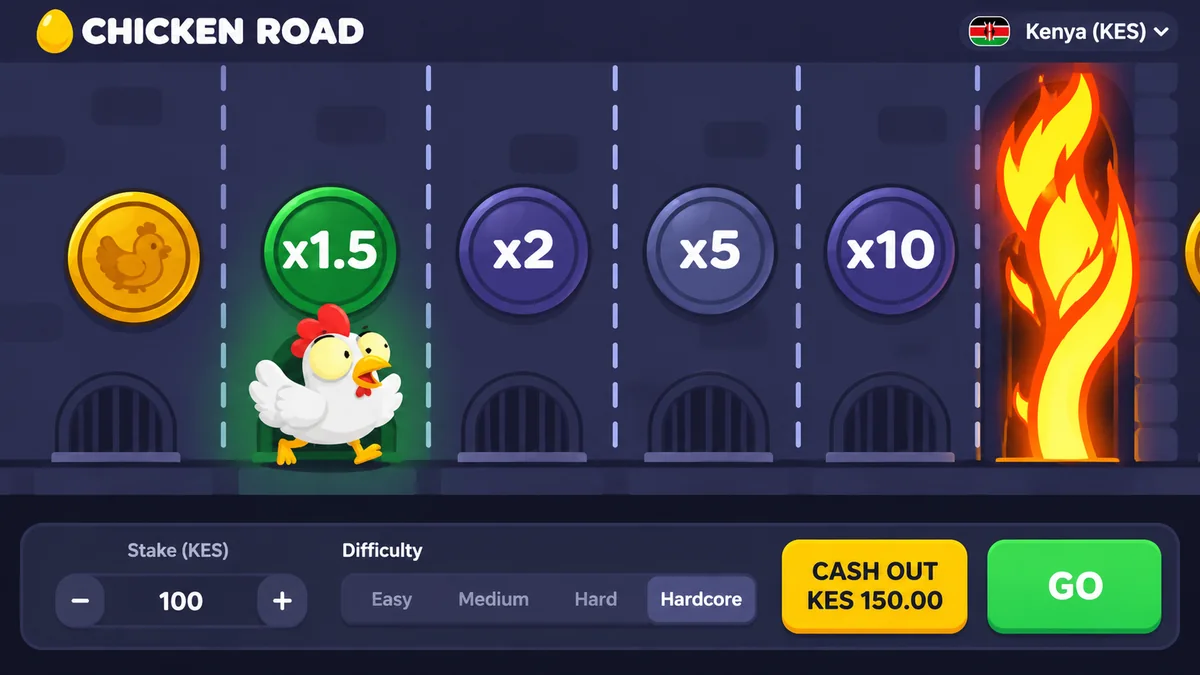
Open the game on a phone in portrait mode and keep your thumb near Cash Out. Rushed taps cost money in a fast session, and a thumb that hovers over Cash Out is harder to mistake.
Easy to Hardcore: what each level does to a round
24 steps, the longest road. The risk behind each tile is the lowest of the four, so cash-outs come more often and growth is slow. Best for learning controls.
22 steps. A higher top multiplier than Easy and more traps along the way. Rounds ending early become common.
20 steps. Large possible multipliers, and a trap can show up within the first few tiles. Bank early or accept frequent losses.
15 steps, the shortest road and the highest risk per tile. The theoretical top is enormous, but the operator's payout cap, listed at $20,000 per round, cuts it.
The rule behind the whole table: the higher the level, the higher the possible multiplier and the higher the risk on each step. The exact risk and the multiplier ladder are not published by the studio, so check the game's info screen. This page does not guess them.
Learn all four levels with play credits before you stake real shillings.
Plan a first session in KES
Decide the budget, then the stake. A session of KES 500 at KES 20 a round gives you up to 25 rounds even if every one ends in a trap. At KES 100 a round the same budget lasts five rounds, which is too few to learn anything.
A first-session checklist
Common mistakes and why they cost money
Raising the stake after a loss is the most expensive habit, because it puts more money behind the same odds. Going for one more step after a good cash-out figure is the second, since a step that looks free carries the same risk as any other. Playing on a tired or irritated evening is the third.
No pattern in earlier rounds tells you the next tile. The strategy page covers budget, targets and stop rules, and the RTP page shows what the game costs on average. Adults only, 18+.
Practise the controls with play credits
Open the game at a licensed operator.